
Hormozgan’s Jahleh: From Ancient Thermodynamic Water Jug to Sacred Clay Percussion
The spherical clay vessel that once chilled drinking water through natural evaporative physics is celebrated today as an acoustic bass percussion instrument in southern Iranian music. A precious craft now safeguarded by only two surviving master potters in Shahvar.
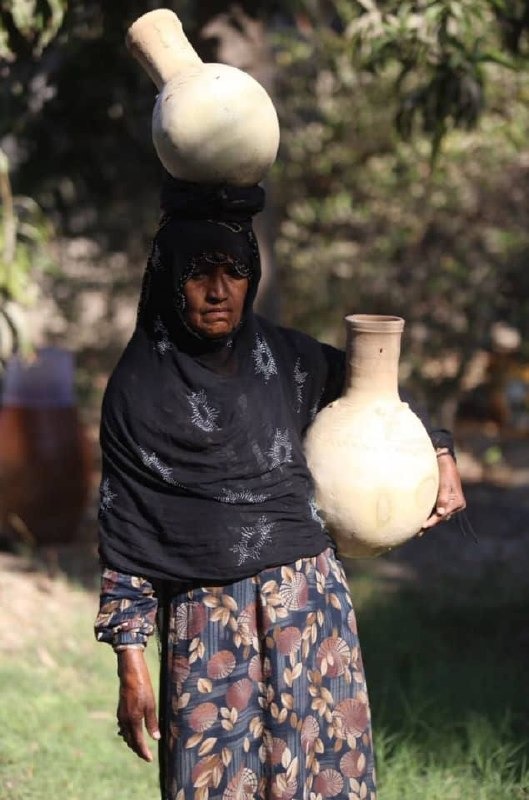
The Jahleh is a spherical earthenware jar deeply woven into the daily life, vernacular engineering, and musical heritage of southern Iran. Its perfectly round base minimizes contact area with the sun-baked ground, curbing heat conduction. Meanwhile, micro-pores in the kiln-fired clay enable capillary seepage, cooling the drinking water through latent heat of evaporation.
Historically, coastal Hormozgani women transported these heavy water vessels with astonishing poise, balancing them upon their heads using a cloth support ring known as a 'Lachek'.
As modern municipal plumbing arrived, the Jahleh evolved rather than vanished. Musicians discovered that striking the vessel's mouth produces a deep resonant bass (Boum), while tapping its curved body creates sharp treble slaps (Tack)—operating on the principles of a Helmholtz acoustic resonator. It became a cornerstone of regional Bandar music alongside the Ney-Anban and Oud.
Today, the knowledge of crafting authentic Jahleh vessels is held by only two surviving elders in Shahvar village near Minab. The Hormozgan Cultural Heritage Custodians Association (HCHCA) is leading field documentation and apprenticeship programs to preserve this irreplaceable art.
Photo Credit: Abdolhossein Rezvani (@visit_hormozgan)